
Advertisement

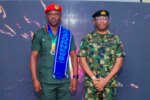
The Commander of the Nigeria Security and Civil Defence Corps, NSCDC, Mining Marshals, Assistant Commandant of Corps (ACC) Attah John Onoja, has urged security agencies to end institutional rivalries and intelligence hoarding to strengthen Nigeria’s fight against insecurity and illegal mining.
Mr Onoja said the country’s security challenges could not be effectively tackled through isolated efforts by individual agencies, stressing the need for intelligence sharing, joint operations and stronger institutional collaboration.

He made the call while delivering a lecture at the third edition of the RazorNews Inter-Agency Cooperation Lectures and Awards held at Shoregate Hotel, Ikeja, Lagos.
Speaking on the theme, “Inter-Agency Synergy for National Security: Strengthening Intelligence Sharing and Joint Operations,” the commander advocated a shift from what he described as “vertical policing” to “horizontal policing”.
He explained that institutional ego, jurisdictional competition and reluctance by security agencies to share intelligence were undermining the collective capacity of Nigeria’s security architecture.
Onoja cited the recent conviction of 15 illegal miners by the Federal High Court in Abuja on November 24, 2026, as an example of the results that could be achieved through effective inter-agency cooperation.
According to him, the defendants were arrested by the Nigerian Army and handed over to the Mining Marshals through the Army Headquarters.
He said the NSCDC subsequently investigated and prosecuted the suspects, leading to their conviction and the imposition of varying prison sentences and fines.
The commander described the development as evidence that institutional trust, intelligence sharing and coordinated enforcement could deliver results that individual agencies might find difficult to achieve independently.
“This is what the power of synergy can deliver,” he said.
He warned that criminals were often the major beneficiaries of disagreements and lack of cooperation among security agencies.
“When agencies hoard intelligence and refuse to work together, criminals benefit. When agencies fight over jurisdiction, criminals escape. When agencies refuse to conduct joint operations, the nation loses,” he said.
Onoja called for joint training programmes, institutionalised intelligence-sharing mechanisms, respect for operational mandates and a security philosophy that places national interest above institutional interests.
He, however, stressed that inter-agency cooperation must be guided by professionalism, accountability and respect for fundamental human rights.
He disclosed that the Mining Marshals had no pending human rights violation case in court.
The commander commended the leadership of the NSCDC Commandant-General, Prof. Abubakar Ahmed Audi, whom he described as an advocate of the three Cs: Collaboration, Cooperation and Coordination.
He said the Mining Marshals were working with the Nigerian Army, Department of State Services, Nigeria Police Force and Nigeria Immigration Service to protect the country’s mineral resources and combat illegal mining.
In his keynote address, delivered on his behalf, the Inspector-General of Police, Olatunji Rilwan Disu, also called for stronger collaboration among security agencies.
Disu said no single security institution could effectively address Nigeria’s complex security challenges without the support of others.
He urged the agencies to improve intelligence exchange, communication, operational planning and institutional relationships, noting that criminal networks frequently operated across jurisdictions and institutional boundaries.
Similarly, the Lagos State Commissioner of Police, Fatai Tijani, underscored the importance of intelligence sharing and joint operations, saying collaboration had contributed to security efforts in the state.
The chairman of the occasion, retired Major General Raymond Ochei, also called for greater institutional trust, warning that rivalry, intelligence hoarding and jurisdictional disagreements could weaken the country’s collective security response.
The event brought together serving and retired security officers, government representatives, community leaders, private-sector stakeholders and media practitioners to discuss ways of strengthening national security through institutional cooperation.
The gathering also featured an awards ceremony recognising individuals and institutions for their contributions to national security, public safety, humanitarian service and inter-agency cooperation.
Among the recipients, the Inspector-General of Police, Disu, received the Outstanding Counter-Terrorism and Counter-Insurgency Service Award, while the Lagos State Commissioner of Police, Tijani, was honoured with the Community Policing and Public Safety Award.
The Commissioner of Police in Ogun State, Olubode Ojajuni, was named Outstanding Police Officer of the Year 2026.
Chief Dr Yeye Afolashade Shona-Aluko, the Yeye Bobajiro Oodua of Yorubaland, received the RazorNews Hero in Philanthropy Award, while High Chief Dr Chidi Anyaegbu, Chairman of Chisco Group, received the RazorNews Humanitarian and Peace Building Award.
Other award recipients included CSP Omolola Opeifa and CC Honey Ogundeyi for their contributions to the security and road safety sectors, as well as Precious Ijeoma Igbowelundu, Adedotun Sunday Kehinde and Mrs Mary Abayomi Fatile.
The Lagos State Commandant’s Office of the NSCDC was also among the institutional award recipients.
The Conveners of Prayer and Support for the Nigerian Armed Forces and other security agencies received the Outstanding Security Sector Cadre of the Year Award in recognition of their support for personnel serving in the country’s security institutions.
Speaking on the initiative, the organiser, Mr Sunday Odita, said the annual event was designed to recognise individuals and institutions contributing to national security while providing a platform for constructive engagement among security agencies, the media and other stakeholders.
The event also highlighted the roles of citizens, traditional institutions and community leaders in strengthening the country’s security architecture.
Onoja, however, maintained that overcoming insecurity, economic sabotage and illegal exploitation of national resources required security institutions to rise above organisational boundaries and embrace a common national purpose.
“Nigeria is bigger than any agency. Nigeria is bigger than any uniform. Nigeria is bigger than any one of us,” he said.