Advertisement
Advertisement

Advertisement

By Fortune Abang, NAN —
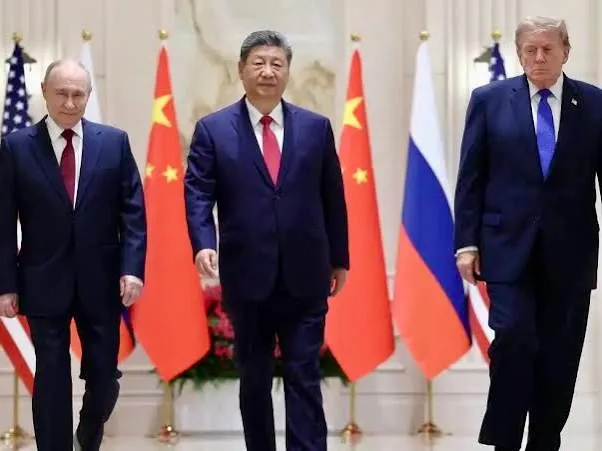
Mixed feelings have continued to trail the historic trilateral meeting of the Chinese President Xi Jinping, U.S. President Donald Trump and Russian President Vladimir Putin.

The meeting tagged: “Trump–Xi–Putin” on the margins of the Asia-Pacific Economic Cooperation (APEC) Summit, held on Thursday in Shenzhen, China.
Analysts opined that the trilateral meeting, which is the first of its kind by the three world leaders, could promote global stability and put lingering global security issues in right perspective.
They expressed diverse prospects of the meeting, while describing it as an unprecedented event that could trigger inexhaustible discussions about way forward to tackling various global teething challenges.
Some of them say the meeting would focus on the Russia-Ukraine war, free movement of vessels in the Strait of Hormuz, solving lingering Gaza crisis and the quest to bring resilience to the supply chain, among others.
Also, about the possibility to stabilise the global world order and its geopolitical turbulence.
Others perceive the meeting to be a G-3 super summit that would offer ray of hope to the African continent, while arguing that such platform could change African nations perspective in dealing with the super powers.
According to the Chinese Foreign Ministry spokesperson, Mao Ning, the trilateral meeting is of groundbreaking significance that would contribute meaningfully to global peace and stability.
“The G-3 leaders will exchange views on safeguarding world peace and promoting strategic stability in relations among major powers, which is of groundbreaking significance.
“Under the current circumstances, the three countries bear an important responsibility to cooperate in tackling global challenges and to promote world peace and stability,” Mao said.
This thought becomes succinct, when considering the fact that China, Russia and the U.S. are founding members of the U.N. and permanent members of the UN Security Council.
China, Russia and U.S. are also reported to have 807 billion dollars’ worth of trade volume combined in goods as of 2025, with China-U.S. trade accounting for over 70 per cent of it, China-Russia for about 28 per cent, and U.S.-Russia for less than 1 per cent.
Suffice to state that the three countries fought together to secure victory in the war against fascism, under current circumstances.

More so, they said it bear significant responsibility for working together to tackle global challenges and promoting world peace, and stability.
Others include strengthening communication, managing and containing differences, and stabilising relations among China, Russia and the U.S.
This trilateral meeting no doubt, analysts stated, could serve the interests of all three countries, meet the expectations of the international community, and help to stabilise the global situation, while promoting dialogue and cooperation.
For Yury Ushakov, Russian Presidential Aide, the meeting has become necessary against all odds, to allay lingering fears of developing nations about underlying conflict of interest among the trio and to form common path toward shared future.
In the same vein, an associate professor of political science at the University of Nevada, Xiaoyu Pu, stated that the meeting is more symbolic than significant when viewed from great-power diplomacy.
Other experts urged African leaders to learn from the unprecedented meeting as a means to advance Africa’s growth.
Dr Collins Nweke, author of Economic Diplomacy of the Diaspora, said that the historic trilateral meeting is an event African countries should learn from, and offers timely illustration, whereby China is using its role as APEC host, to convene separate conversation with Washington and Moscow.
According to him, the APEC summit reflects the region’s economic diversity, bringing together advanced industrial economies, emerging markets and developing countries.
Nweke, who is also a global affairs analyst, said, “African governments can use major gatherings in the same way, bringing leaders, investors and development banks together around issues where African countries have a stake and a proposal ready to negotiate.”
This, according to him, for Nigeria and Africa, the lesson is to engage every major power with priorities of our own and act together where interests coincide, saying that is how the continent’s influence could be gained in changing world order.
The stakeholders believe the Shenzhen event is a test of rival powers making their competition less dangerous, bearing that Washington wants to open a conversation on nuclear arms.
They also believe that such reasons could produce something useful, if the leaders agree to keep talking, exchange information or improve how they communicate in a crisis.
More than that, they expressed confidence the trilateral meeting would bring about practical steps to reduce tensions in the Gulf and that countries affected would be brought into decisions about their own future.
NANFeatures