Advertisement
Advertisement

Advertisement

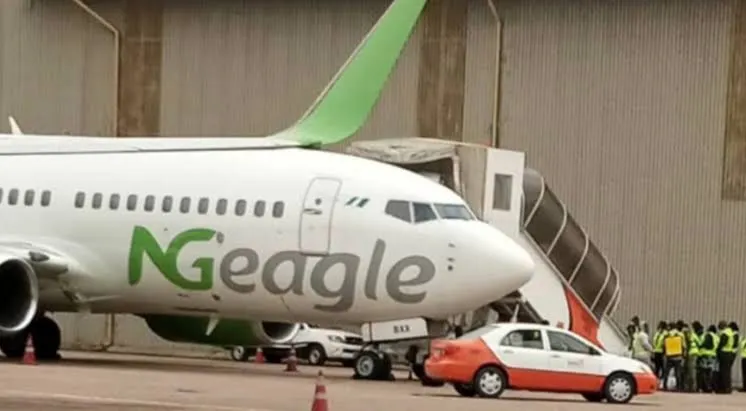
A prosecution witness in the alleged N76bn and $31.5m fraud involving the Asset Management Corporation of Nigeria, AMCON, has told a Lagos court how assets worth N4.9bn belonging to Arik Air were allegedly diverted to establish and fund NG Eagle Airlines.
The witness, Bawa Usman Kaltungo, said the Economic and Financial Crimes Commission (EFCC) established that Arik Air’s resources were used to finance the operations and establishment of NG Eagle, which was subsequently sold for about N149m.

Kaltungo, the fourth prosecution witness in the trial, disclosed this on Wednesday while being cross-examined by defence counsel, Olasupo Shasore, SAN, before Justice Mojisola Dada of the Special Offences Court sitting in Ikeja, Lagos.
The defendants are a former Managing Director of AMCON, Ahmed Kuru; Kamilu Alaba Omokide; Roy Ilegbodu; Union Bank of Nigeria Plc; and Super Bravo Limited.
They are facing a six-count charge bordering on conspiracy, stealing and abuse of office.
During cross-examination, Kaltungo said the EFCC invited Arik Air’s former Chief Financial Officer, Jonathan Sani, during its investigation, and obtained a breakdown of expenses incurred in establishing and funding NG Eagle.
“The Chief Financial Officer of Arik Air was invited by the EFCC for questioning, and he gave us the breakdown of all the expenses,” he said.
He added that Sani provided additional details in a further statement to investigators.
The witness maintained that the investigation established that Arik Air’s funds were used to meet expenses associated with NG Eagle, raising questions about the management of the airline’s assets during its receivership.
He explained that Ilegbodu, who served as chief executive officer of Arik Air under receivership, handled the airline’s technical operations and reported to Kuru, while Omokide, then AMCON’s Group Head of Asset Management, served as receiver-manager of the airline.
On the dismantling of an Arik Air aircraft, with registration number 5N-JEA and valued at $31.5m, Kaltungo said the EFCC investigation found that the exercise was carried out without approval from the Nigerian Civil Aviation Authority (NCAA).
He said investigators obtained intelligence from some AMCON officials and examined email correspondence between Ilegbodu and an individual identified as Olanrewaju concerning the removal of parts from the aircraft.
According to him, the correspondence contained instructions to remove some important components while leaving others behind.
Although the emails did not mention Omokide, Kaltungo insisted that the dismantling could not have taken place without the receiver-manager’s approval or consent.
He also told the court that EFCC investigators encountered a blockade during an inspection visit but eventually gained access to the aircraft and examined its condition.
The witness further disclosed that three Arik Air aircraft were transferred to Super Bravo Limited on December 31, 2020, before the expiration of a 90-day deadline issued by AMCON for the airline to service its foreign loan.
He said Super Bravo was incorporated by AMCON in 2013 and that the transfer of the aircraft formed part of the transactions investigated by the EFCC.
According to him, AMCON sought approval from its board for the transfers several years after the transactions had taken place.

Kaltungo alleged that the transfer gave NG Eagle an undue advantage, adding that investigators observed Arik Air aircraft being repainted and converted for use by the new airline.
On the alleged loan Union Bank claimed Arik Air owed it, the witness said investigators could not obtain an offer letter or account statement establishing the transaction.
He said the bank failed to provide documents supporting its claim, while Arik Air told investigators that it had not obtained a loan from the financial institution.
One of the charges against Union Bank alleges that the bank made false statements to AMCON in 2011 concerning Arik Air’s performing loans, leading to the transfer of a purported N71bn debt to the corporation.
Earlier, during proceedings on Tuesday, Kaltungo was cross-examined on his investigation report concerning the incorporation of NG Eagle and Super Bravo, as well as the circumstances surrounding the sale of NG Eagle.
The witness told the court that he conducted the investigation and prepared the report but did not file the charges against the defendants.
He said the EFCC’s legal team reviewed the case file before deciding on the charges.
Kaltungo acknowledged that the proceeds from the sale of NG Eagle, amounting to approximately N149m, were paid into AMCON’s account domiciled with the Central Bank of Nigeria.
He, however, said Kuru approached the AMCON board to obtain approval for the sale three years after the assets had been sold.
On Exhibit P18, a document obtained from the Corporate Affairs Commission (CAC), the witness clarified that it originated from the commission and not AMCON.
When asked whether the document expressly stated that Omokide instructed a lawyer to incorporate the company, Kaltungo admitted that it contained no such explicit statement.
He argued, however, that the incorporation of a company would ordinarily involve the directive or approval of its chief executive, whether given verbally or in writing.
The witness also acknowledged that a court judgment concerning the incorporation of NG Eagle, which investigators considered, had subsequently been set aside on appeal.
He, however, said the investigation also relied on a legal opinion from the Attorney-General of the Federation.
Kaltungo further told the court that AMCON confirmed incorporating NG Eagle and Super Bravo.
He also acknowledged that Kuru was neither listed as a director nor a shareholder in either company and that investigators did not trace any payment from Super Bravo to him.
Justice Dada adjourned the case until December 3 and 10, 2026, for continuation of trial.