Newspapers in Nigeria reported on a variety of issues ranging from the candidates list for the 2027 Elections to the ramping up of contact tracing by the Nigerian Centre for Disease Prevention and Control for the index Ebola case to the fears over year end fuel supply as the crisis……
Newspapers in Nigeria reported on a variety of issues ranging from the candidates list for the 2027 Elections to the ramping up of contact tracing by the Nigerian Centre for Disease Prevention and Control for the index Ebola case to the fears over year end fuel supply as the crisis in the strait of Hormuz and the wider middle east continues.
Other issues from the sports and entertainment sectors also got prominent mentions.
1. The Punch leads with the continuing efforts by the Nigerian Centre for Disease Prevention and Control to beat the Ebola outbreak in the country through contact tracing and states level treatment across the country.
The Federal Government is planning to identify and equip Ebola treatment centres in states with designated ports of entry as the number of identified contacts linked to Nigeria’s confirmed case rises to 53.
The measures are part of efforts to strengthen the country’s preparedness for a possible spread of the disease, with the government assessing isolation capacity at the University of Abuja Teaching Hospital and planning an infection prevention and control assessment at Karu General Hospital.
According to an Ebola situation report obtained by our correspondent on Sunday, the authorities are also working to establish referral mechanisms for suspected cases, strengthen surveillance at ports of entry and improve the capacity of healthcare facilities to manage possible infections.
The FG is also strengthening preparedness for the Ebola outbreak by assessing isolation. Read more in The Punch
2. The Guardian also stays on the Ebola fight with a focus on the number of people currently under observation.
As the Federal Government intensifies efforts to contain the Ebola Virus Disease outbreak, states are stepping up surveillance and preparedness measures, with Lagos strengthening screening at the Murtala Muhammed International Airport and public enlightenment, while health experts warn of critical gaps in the country’s intensive care infrastructure.


The Nigeria Centre for Disease Control and Prevention (NCDC) has identified 53 primary contacts of Nigeria’s confirmed case, most of whom are under quarantine and public health surveillance, as it expands screening at international airports to cover passengers arriving from all countries. The agency also identified a suspected case in Rivers State, which subsequently tested negative.
The developments have renewed concerns about the readiness of state health systems to detect and contain possible infections, isolate suspected cases and manage patients requiring specialised care. Read more in The Guardian
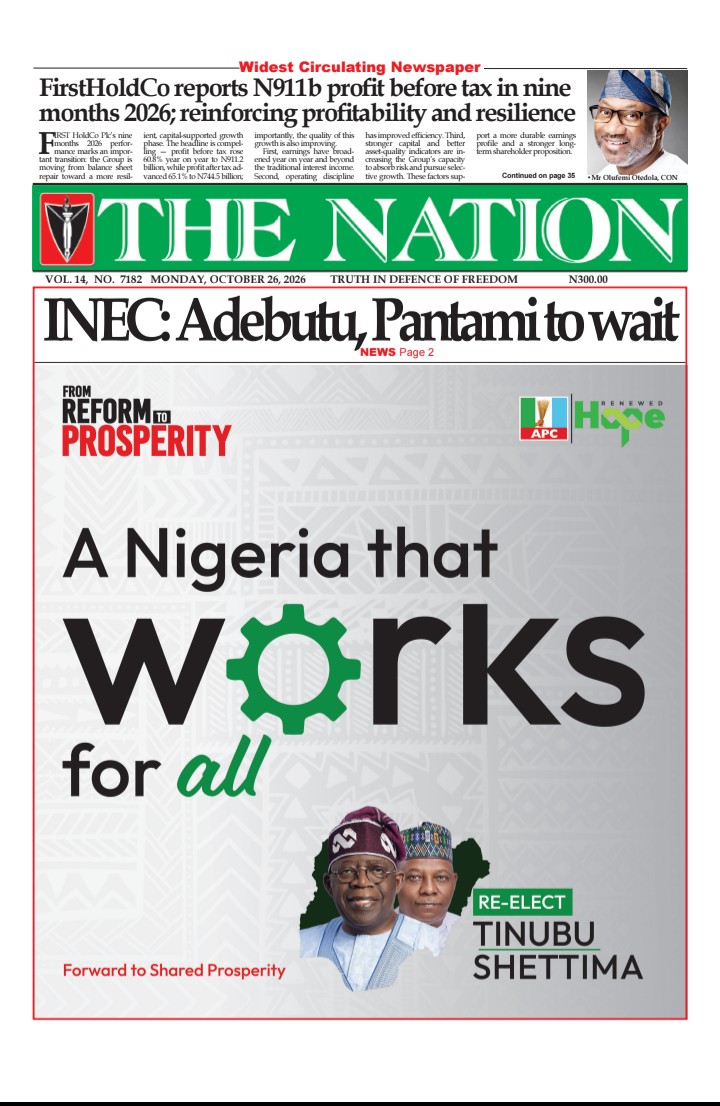
3. The Nation for its part leads with the stories from the Political sphere with particular focus on the revised candidates list and the date of publication by the Independent National Electoral Commission.
Governorship candidates omitted from the final list published by the Independent National Electoral Commission (INEC) will have to wait a little longer to know their fate.
The electoral body excluded their names following the September 24 Supreme Court judgment, which upheld the provisions of the Electoral Act 2026.
It gave affected candidates until Saturday to submit their objections through their political parties.
Among the affected candidates are Oladipupo Adebutu of the Peoples Democratic Party (PDP) in Ogun State; Isa Ali Pantami of the PDP in Gombe State; and Aminu Gwarzo of the Nigerian Democratic Congress (NDC) in Kano State. BuyMaps
The candidates are awaiting INEC’s decision on their appeals to know whether they will participate in next year’s governorship elections. Read more in The Nation
4. Leadership leads with a story on the nations’ premium motor spirit stock raising fears that an end of year shortage may happen.
Nigeria’s petrol stock cover has remained below the 30-day safety benchmark for seven consecutive months, raising concerns about possible supply constraints towards the end of the year as petroleum marketers reportedly reduce imports amid claims that banks have declined to issue Letters of Credit (LCs) to importers.
The concerns come as data from the September 2026 factsheet of the Nigerian Midstream and Downstream Petroleum Regulatory Authority (NMDPRA) show declining petrol imports and domestic deliveries ahead of the festive season.
According to the factsheet, petrol stock cover stood at 23.9 days in September, up from 22.9 days in August but still 6.1 days below the required 30-day threshold.
Stock cover fell from 30.9 days in February to 21.2 days in March, before reaching its lowest point of 16.2 days in May. It has since risen for four consecutive months, increasing to 19.6 days in June, 22.4 days in July, 22.9 days in August and 23.9 days in September.
The average stock cover over the seven-month period was approximately 20.6 days. Inland depots accounted for 22.7 days of the September cover, while the NMDPRA’s calculation also included petrol stocks at the Dangote refinery.
Despite remaining below the safety benchmark, the September position was better than the corresponding period last year, when stock cover stood at 16.9 days before falling further to 11.1 days in October 2025.
However, the pace of recovery has slowed. Stock cover increased by 2.8 days between June and July, but the gains narrowed to 0.5 days in August and one day in September. Read more in The Leadership
5. Vanguard leads with a story on the decline of credit by banks to manufacturing companies across the country.
Loans extended by Nigerian banks to the manufacturing sector fell by 26.8 per cent year-on-year to N5.19 trillion in the first half of 2026 (H1’26), from N7.09 trillion in the corresponding period of last year (H1’25).
This comes as manufacturers grappled with persistent financing constraints and rising operating costs.
The decline also comes amid concerns over the availability of affordable, long-term funding for industrial production, with the Manufacturers Association of Nigeria (MAN) calling for stronger credit guarantees and the full operationalisation of a N1 trillion Manufacturing Stabilisation Fund.
Data from the Central Bank of Nigeria’s (CBN) Q2 2026 Statistical Bulletin also indicated a sustained decline as the outstanding bank credit to manufacturers declined by about 21 per cent between January and June 2026, from N6.57 trillion to N5.19 trillion.
The 2026 monthly figures showed that credit fell from N6.57 trillion in January to N6.37 trillion in February, N5.77 trillion in March and N5.32 trillion in April. It declined further to N5.02 trillion in May before a slight recovery to N5.19 trillion in June.
Despite the slight month-on-month recovery, the June figure remained substantially below the level recorded in the previous year.
The contraction highlights the financing challenges confronting manufacturers amid high production costs, expensive electricity, logistics bottlenecks and exchange-rate pressures. Read more in Vanguard