
Advertisement

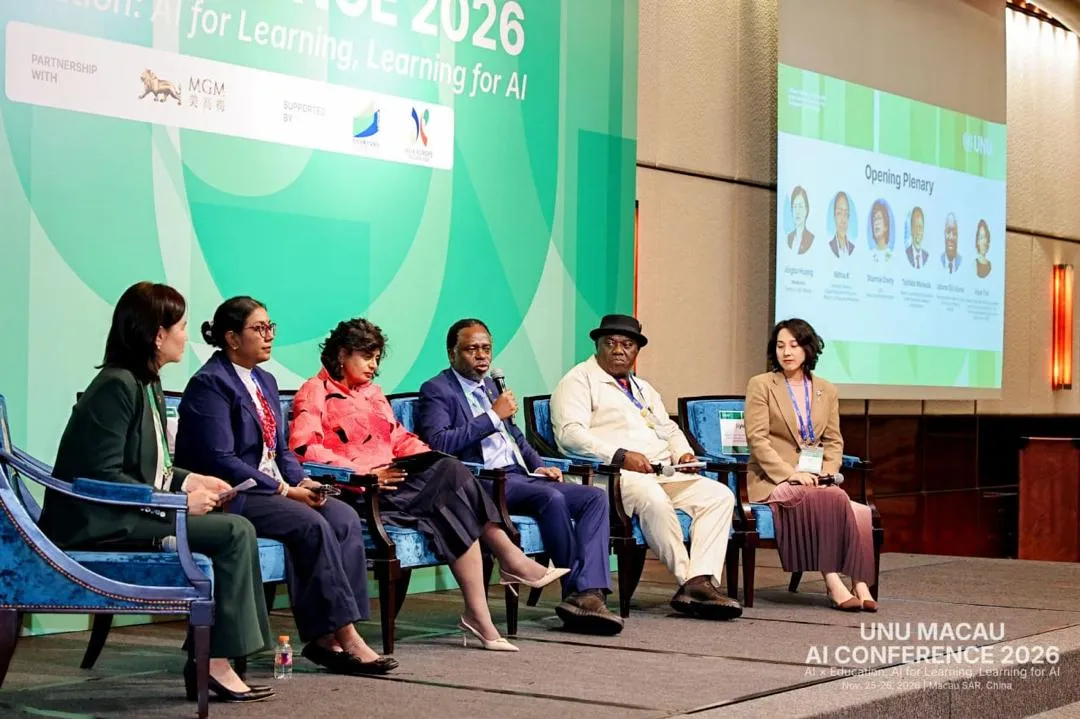
The Vice-Chancellor of the National Open University of Nigeria, NOUN, Prof. Uduma Oji Uduma, has warned against allowing Artificial Intelligence, AI, to replace teachers and undermine human values in education.
Uduma said AI should remain a tool for improving learning rather than a substitute for human beings, urging the global education community to place people at the centre of every AI policy and innovation.

He spoke at the opening plenary of the UNU Macau AI Conference 2026, themed “AI × Education: AI for Learning, Learning for AI”.
“AI should not be made to replace but assist human beings,” he said.
“In all we do with AI, let us put the human being at the centre. Let AI assist us. Let us interrogate information. And let us ensure that as education expands, humanity is not lost.”
The conference brought together policymakers, lecturers, researchers and young innovators from more than 114 member institutions across six continents to examine the impact of AI on teaching, learning and assessment.
A veteran of open and distance learning, Uduma said technology had long played a critical role in distance education, but the rapid integration of AI into schools and everyday life had created new opportunities and challenges.
He said AI could help teachers reach more students, enable learners to study at their own pace and make large classes more interactive.
However, he warned that the technology must support teachers rather than take over their responsibilities.
On examinations and assessment, the vice-chancellor urged students and teachers to scrutinise AI-generated information rather than accept it blindly.
“Put AI answers in parenthesis,” he said, stressing the need to interrogate information and verify its accuracy.
Uduma also warned that Africa must not allow other regions to determine how AI would be deployed in its education sector.
He said the continent must actively participate in shaping AI policies and ensure that investments by technology companies translate into meaningful development.
According to him, foreign investments in Africa should prioritise building local capacity, infrastructure and institutions rather than focusing solely on profit.
He used the proverb that investors wanted to “fatten the cow before eating it” to illustrate the need for technology companies to strengthen Africa’s development before seeking returns.
The NOUN vice-chancellor identified inadequate electricity, internet access, insecurity and poor governance as major obstacles to the continent’s readiness for AI-driven education.
“Without light, there is no learning. Without internet, AI cannot reach the child in a village. Without security, schools and students are not safe. And without good leadership and clear policies, even the best tools will go to waste,” he said.
He called for sustained investment in infrastructure and global support to enable Africa to compete with developed economies.
“Africa requires more infrastructure to be able to keep pace with the developed world,” he added.
Uduma said preparing teachers for the AI era should be a priority, noting that educators needed training in how to use the technology effectively, including how to ask appropriate questions to obtain useful responses.
He said a good question could produce a useful answer, while a poorly framed question could generate confusion.
The vice-chancellor also called for a review of teaching methods, assessment systems, teacher training and policies governing the activities of major technology companies.
He said AI should improve access to education for women in remote communities, students with disabilities, workers studying at night and mothers unable to attend physical lectures.
According to him, the technology could help overcome barriers relating to language, distance and cost, but only if its development takes African languages, realities and learners into consideration.
He warned that AI tools designed without such considerations could widen the gap between the rich and the poor.
On the risks of misinformation, examination malpractice and overdependence on technology, Uduma urged educational institutions to teach students critical thinking, information verification and independent reasoning.
He also called for clear regulations and effective human oversight to ensure responsible use of AI in education.
The vice-chancellor said AI would change the role of teachers rather than eliminate it, with educators increasingly serving as guides and mentors who help students develop critical thinking skills.
He added that universities would remain relevant but must rethink their teaching, assessment and student support systems to meet the demands of the AI era.
Uduma urged African institutions to strengthen their research capacity and develop solutions to challenges facing the continent.
He said distance learning, supported by AI, could help meet the growing demand for flexible and affordable university education, particularly in Africa, which has the world’s youngest population.
However, he insisted that the technology must be deployed in a way that upholds human values and ensures that no learner is left behind.